
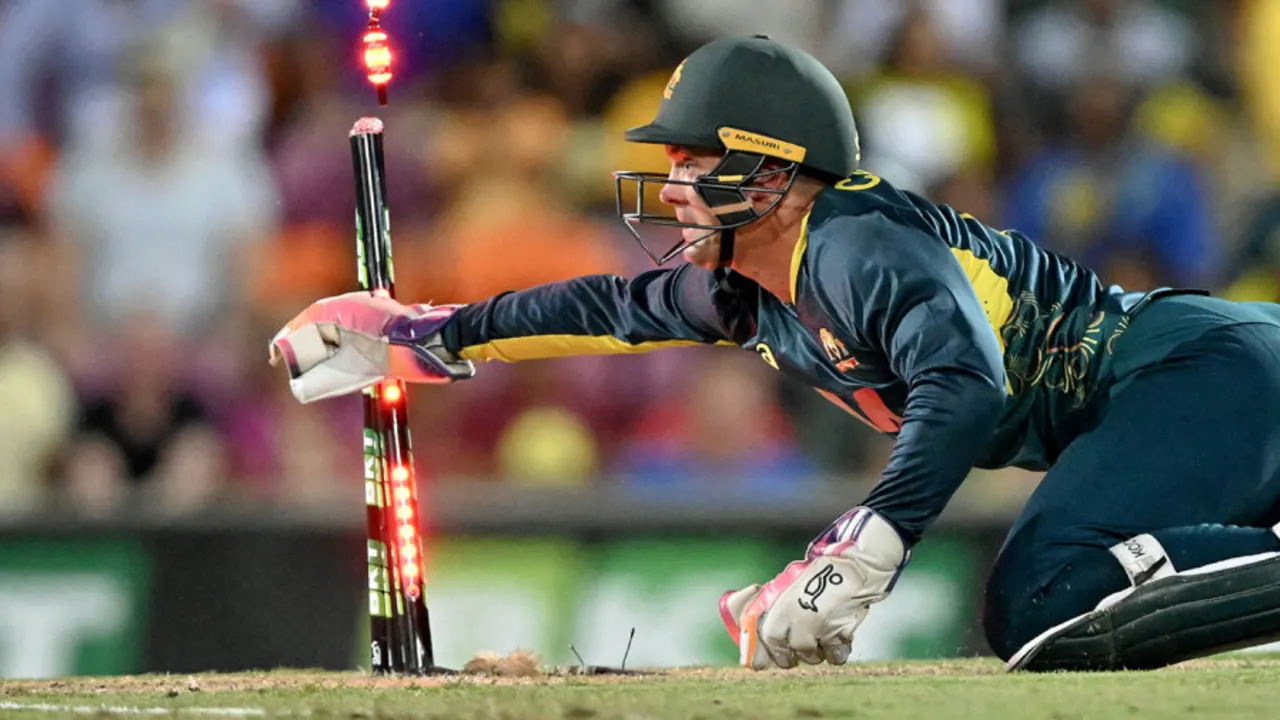
The second T20I in Darwin showcased Dewald Brevis’ stunning century, but it also raised a pressing question for Australia ahead of the T20 World Cup: should the squad include a wicketkeeping back-up? Josh Inglis remains Australia’s primary white-ball keeper, but his recent flu and chronic back issues make reliance on him alone a risky proposition.
Alex Carey was flown in as a replacement, marking his first T20I since 2021. Carey’s performance was notable, he scored 26 off 18 balls and executed a brilliant stumping to dismiss Lhuan-dre Pretorius. This highlighted the value of having a ready back-up for key roles in high-pressure matches.
While replacing a player is simple in a home bilateral series, global tournaments are far less forgiving. Squad sizes are limited, replacements require official approval, and once a player exits, they cannot return. Australia must carefully weigh its options to avoid leaving itself exposed in crucial T20 World Cup fixtures.
Josh Inglis: Australia’s First-Choice Keeper
Fitness and Form
Josh Inglis has cemented his role as Australia’s primary T20 white-ball keeper. His consistent glove work and batting make him a reliable option. Despite this, his ongoing back issues could restrict availability in a compressed tournament. His recent flu during the Darwin series also highlights vulnerability. Ensuring he remains fit is vital for Australia’s T20 World Cup strategy.
Tournament Risks
Relying solely on Inglis brings inherent risks. Any minor injury or illness during the T20 World Cup could force a compromise in the squad. Tournament rules do not allow easy short-term replacements. This could leave Australia scrambling for a makeshift keeper mid-event. Proper contingency planning becomes essential for success.
Strategic Importance
Inglis’ presence enables flexibility in batting and fielding. Without a backup, team balance could be disrupted if he becomes unavailable. A second keeper provides insurance against unforeseen circumstances. It also allows for workload management in back-to-back matches. Strategic planning ensures the squad remains robust under pressure.
Alex Carey’s Role in T20I
Recent Recall
Carey’s recall in Darwin demonstrated his reliability. Scoring 26 off 18 balls and effecting a stumping, he proved his match readiness. His experience offers a dependable contingency if Inglis misses a game. Quick adaptation to the team environment also highlights his professionalism. Carey remains a credible candidate for World Cup inclusion.
Batting Versatility
Carey has primarily batted in the top order but can adapt to lower-order roles. His T20 strike-rate of 129.04 shows steady scoring ability. Recent BBL seasons lifted this to 146.52, surpassing Inglis’ strike-rate over the same period. This versatility strengthens Australia’s options in the batting lineup. He can provide depth without weakening overall team performance.
Wicketkeeping Skills
Carey’s keeping skills remain dependable for international competition. He offers reliable glovework alongside competent batting. This dual ability allows selectors to maintain squad balance. His presence provides tactical flexibility for rotation. Having Carey reduces the risk of playing without a specialist keeper.
Historical Context: Wicketkeeping Back-Up
2022 T20 World Cup
Australia almost faced a crisis when Matthew Wade fell ill against England. Backup options were limited as Inglis had prior injuries. Non-specialists like David Warner and Aaron Finch were considered temporarily. The situation highlighted the need for contingency plans. Lessons from this scenario are directly relevant for the upcoming World Cup.
Previous Tournament Decisions
In past T20 World Cups, Australia included multiple keepers in the squad. This strategy allowed rotation, injury cover, and tactical flexibility. Inclusion of more than one keeper ensured uninterrupted performance. It also helped maintain batting and fielding quality. Such historical precedents guide current squad planning decisions.
Lessons Learned
Past experiences underline the value of a second keeper. Teams without proper contingency have struggled under unexpected circumstances. Having an additional wicketkeeper ensures stability. It also enhances team confidence during high-pressure matches. Lessons learned inform Australia’s approach to the upcoming T20 World Cup.
Emerging Options: Jake Fraser-McGurk
Developmental Focus
Jake Fraser-McGurk has been included in tours to develop his keeping skills. He primarily remains a batter but is gaining wicketkeeping experience. His development is aimed at providing a future option for Australia. Exposure to international matches enhances readiness. The strategy ensures potential successors are available for major tournaments.
Performance Challenges
Fraser-McGurk’s batting form is inconsistent, averaging 19.41 in T20s this year. While his strike-rate of 150.22 is impressive, his reliability is limited. These factors reduce his immediate readiness for the World Cup. Inclusion would require balancing potential against risk. Selectors need to consider these performance metrics carefully.
Potential Role
He may keep for Australia A in one-day series to gain practical experience. This exposure helps him prepare for senior team responsibilities. Currently, he is not a viable option as a primary squad member. Developing talent ensures long-term depth in the wicketkeeping pool. For now, he is a backup-in-training rather than a tournament-ready replacement.
Balancing Squad Composition
Depth vs. Versatility
Including Carey enhances squad depth but may reduce options elsewhere. Every T20 World Cup squad has only 15 spots. Choosing between batting depth and wicketkeeping security is critical. Careful balance ensures team competitiveness. Strategic prioritization maintains overall squad effectiveness.
Strategic Trade-Offs
Selecting a backup keeper may displace a frontline batter or allrounder. Decisions affect batting order flexibility and bowling options. Tournament success often hinges on making the right trade-offs. Each position in the squad must be optimized. This is where selectors’ judgment becomes vital.
Tactical Considerations
A dual-role player like Carey provides tactical flexibility. He can cover for injuries while contributing as a batter. This allows Australia to manage workload across matches. Rotational options reduce fatigue risks. Tactical planning ensures consistent performance throughout the tournament.
Strategic Implications for the T20 World Cup
Injury Management
A backup keeper ensures continuity if Inglis suffers injury or fatigue. T20 tournaments are physically demanding, with little recovery time. Proper planning prevents disruptions in key matches. It also safeguards team morale under pressure. Injury management is crucial for consistent performance.
Rotational Flexibility
Including a secondary keeper allows rotation to maintain peak performance. Players can rest without weakening the team. This flexibility is valuable in a compact tournament schedule. Squad rotation helps sustain performance levels. It also ensures long-term fitness for key players.
Team Confidence
Knowing a capable deputy is available boosts team confidence. Players can focus on their roles without fear of gaps. This creates a stable, prepared environment. Confidence is critical in high-stakes matches. Backup options underpin strategic planning and resilience.
FAQs
Why does Australia need a backup wicketkeeper?
Australia needs a backup to ensure continuity if Josh Inglis is unavailable due to injury or illness. Having a reserve reduces risk of disruption in crucial T20 World Cup matches.
Has Alex Carey played T20Is recently?
Carey returned in the Darwin T20I in 2025, scoring 26 runs and executing a stumping. His performance shows he can step in effectively when required.
Can Jake Fraser-McGurk serve as a backup?
Fraser-McGurk is being developed as a wicketkeeper but lacks consistent form in T20 batting. He is currently more of a long-term option than a tournament-ready choice.
How did Australia manage keeper issues in past tournaments?
In emergencies, Australia relied on non-specialists like David Warner or Aaron Finch to fill in. This demonstrated the risks of not having a dedicated backup keeper.
What are the risks of not having a backup keeper?
Without a backup, Australia could face squad imbalance or weakened performance if Inglis becomes unavailable. The team may have to rely on less experienced or non-specialist players in key matches.
Conclusion
Australia faces a key T20 World Cup decision: whether to include a wicketkeeping back-up alongside Josh Inglis. Alex Carey offers proven skills as both a batter and keeper, while emerging players like Jake Fraser-McGurk provide developmental options. Selecting a secondary keeper ensures squad balance, tactical flexibility, and injury insurance. Careful planning will allow Australia to enter the tournament fully prepared, minimizing risk and maintaining consistent team performance throughout.
